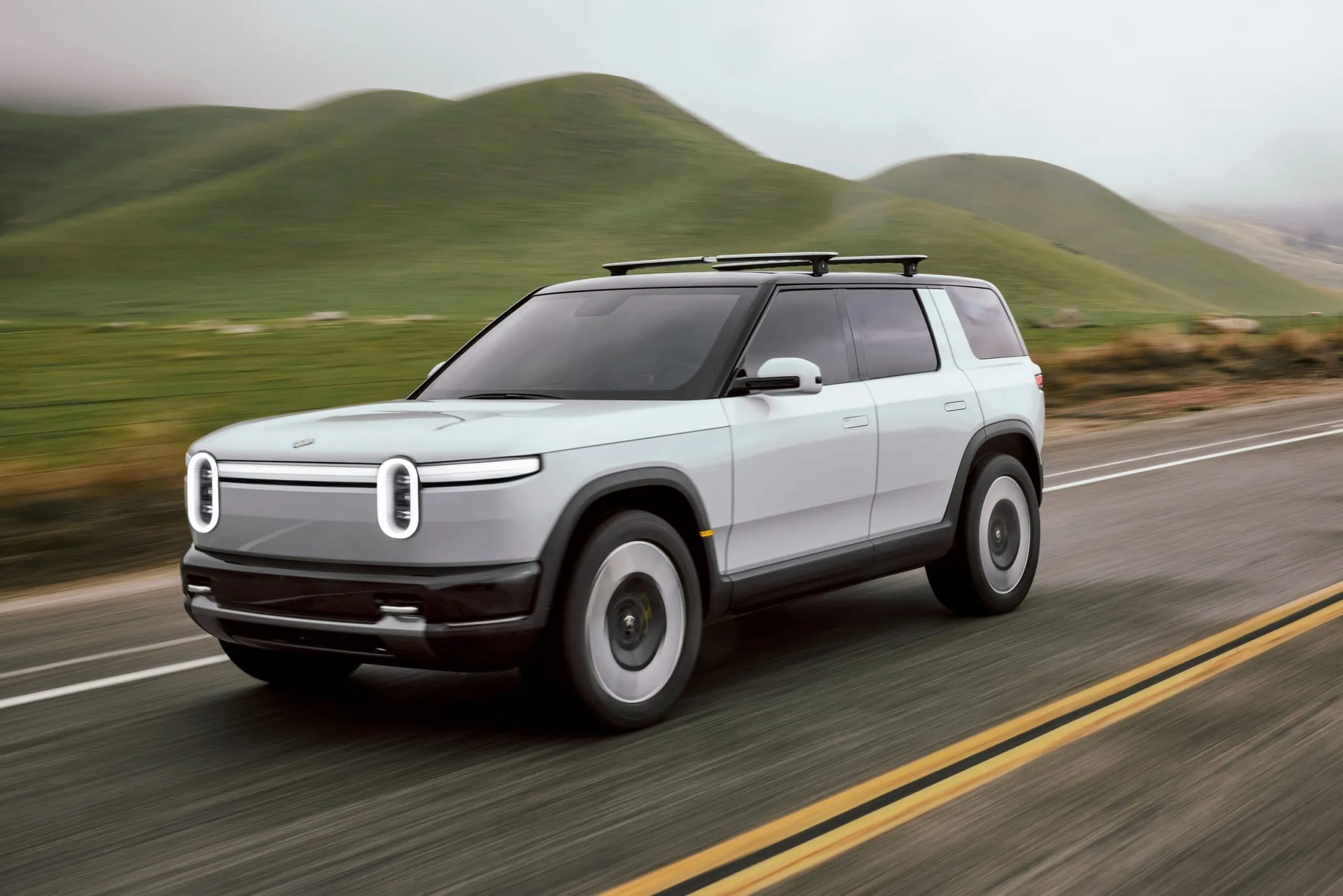
The Rivian R2: Everything You Need to Know About the EV That Survived a Tornado and Nailed the Landing

Some car companies announce a new vehicle, build the hype, and then quietly delay it. Rivian announced a new vehicle, had a tornado rip the roof off the factory where it was being built, started production anyway five days later, and then delivered a vehicle that landed on best-of-year lists from writers who normally spend their careers with Ferraris and Lamborghinis. As far as comeback stories go, the Rivian R2 already wins 2026.
But a good story doesn’t make a good car. So let’s set the drama aside and talk about what the R2 is, what it costs, how it drives, and whether it deserves the reception it’s getting.
What Is the Rivian R2?
The R2 is Rivian’s play for the mainstream. It’s a midsize, five passenger electric SUV built on an entirely new platform, designed to sit below the larger R1S and R1T in both size and price. The target on the wall? The Tesla Model Y, which has owned this segment for years. CEO RJ Scaringe has said from the beginning that the R2 is the vehicle the company needs to reach everyday buyers. The R1 lineup is excellent, but when your base price starts in the mid $80,000s, the word “mainstream” is working overtime.
Rivian first showed the R2 in prototype form back in March 2024 at a splashy event in Laguna Beach, California, with a promised starting price of $45,000. The response was immediate. Over 68,000 people put down $100 deposits in the first 24 hours, and that number kept climbing. It passed 100,000 by mid 2024 and reportedly topped 200,000 by early 2025. That’s a lot of people betting real money on a vehicle they’d only seen in prototype form, from a company that was still burning cash. It also tells you something about how R1 owners talk about their cars. People don’t reserve a second Rivian unless the first one made an impression.

From Tornado to Timeline to Production Line
In mid April 2026, an EF1 tornado tore through Rivian’s factory in Normal, Illinois, and hit Building 2, the section dedicated to R2 production. The roof came off. Parts of the structure came down. It was the kind of event that gives project managers nightmares and shareholders heart palpitations.
Rivian’s response? CEO Scaringe sent staff an email that Sunday night, the team was back at it Monday morning, and five days later he drove the first customer ready R2 off the production line. That’s not spin. That happened. From “the roof is gone” to “here’s your car” in less than a week.
The first units went to Rivian employees, with customer configuration invitations rolling out in June. By June 9, the first customer deliveries were happening, and Rivian did something unusual. They lifted the media embargo on production vehicles the same day. That’s a move you only make when you know the reviews are going to be good, because if they’re not, you just handed every automotive journalist a megaphone and a reason to use it. Rivian bet on themselves. It paid off.
The Specs
The R2 is roughly the same length as a Honda CR V but sits on a wheelbase almost 10 inches longer, which translates to a spacious interior for a vehicle this size. It’s also about 1,350 pounds lighter than the R1S, thanks to an all new unibody platform that replaced the R1’s heavier body on frame architecture.
Length: 185.9 inches Width: 78.1 inches (84.7 with mirrors) Height: 66.9 inches Wheelbase: 115.6 inches Ground clearance: 9.6 inches (best in class) Curb weight: Approximately 5,250 pounds (Performance) Approach / Breakover / Departure: 25 / 20.6 / 26 degrees Seating: Five passengers, two rows Total storage: 90.1 cubic feet Cargo behind rear seats: 28.7 cubic feet Towing: Up to 4,400 pounds with tow package (Model Y tops out at 3,500)
Trims, Pricing, and the Fine Print
Rivian isn’t launching all four trims at once. They’re rolling them out over the next year and a half, starting at the top and working down. If you’ve been hearing “$45,000” since 2024, you should know that version isn’t the one you can buy today.
R2 Performance with Launch Package — $57,990 Available now. Dual motor AWD, 656 horsepower, 609 pound feet of torque, 3.6 seconds to 60, 330 miles of range. Semi active suspension, standard tow package, lifetime Autonomy+ access, and exclusive Launch Green paint. Also comes with yellow brake calipers, because apparently that’s how you know a car is fast.
R2 Premium — $53,990 Expected late 2026. Dual motor AWD, 450 horsepower, 4.6 seconds to 60, 330 miles of range. Same core features as the Performance minus the semi active suspension and the bragging rights. For a lot of buyers, this will be the sweet spot.
R2 Standard — starting at $44,990 Expected 2027. Single motor RWD, with AWD available as an upgrade. Rivian’s own R2 page currently lists Standard as “starting at $44,990” and its EPA ranges are still preliminary, but earlier communications point to somewhere between 265 and 345 miles depending on configuration. Rivian is releasing the Standard in stages, with a longer range single motor variant landing first in early 2027 and the entry level base version arriving later. The $44,990 sticker is the price Rivian has promoted since 2024, and it’s real, but for now the only configurable trim is the $57,990 Performance. That’s roughly a $13,000 gap between the headline price and what a first buyer can drive home today.
Battery and Charging
The R2 runs on an 87.9 kWh battery (usable capacity) using Rivian’s new 4695 cell format, developed specifically for this platform. It’s a meaningful cost reduction from the R1’s battery system, which is part of how Rivian gets the price down.
Fast charging hits 10 to 80 percent in under 30 minutes on a DC charger. The charging port is native NACS (the Tesla standard), with CCS compatibility through an adapter.
The R2 uses 400 volt architecture, while competitors like the Ioniq 5 and EV6 run 800 volt systems that can charge faster at peak rates. Rivian made this call partly for cost and partly because Tesla’s Supercharger network, which most R2 owners will use, currently plays nicer with 400 volt vehicles. It’s a pragmatic decision, not a performance one. Whether it matters depends on how often you’re road tripping and how you feel about spending 30 minutes at a charger. Personally, I think 30 minutes is fine. Just long enough to use the restroom, buy a terrible gas station sandwich, and scroll through your phone pretending you’re not eating a terrible gas station sandwich.
The R2 in Context
Edmunds called the R2 “a normal car for everyday people” that “will fit neatly around most of their needs.” That reading matches what Rivian said they were building here: not a technology showpiece, but a proper first EV for buyers who wanted the R1 to be smaller and cheaper.
Marques Brownlee (MKBHD) was one of the first non-Rivian drivers behind the wheel of the R2 during prototype testing in February. He framed it as Rivian’s Model Y fighter and compared its role in Rivian’s growth to what the Model 3 and Y meant for Tesla.
Men’s Journal‘s Michael Teo Van Runkle called the R2 his best car of the year after a career that includes driving Ferraris and Lamborghinis. Treat that as a first-drive signal that the R2 does something specific well, not as a settled verdict on long-term ownership, which is going to take time to shake out.
InsideEVs headlined its prototype review “It’s Going to Surprise People,” and flagged the power, the lighter weight, and the build quality alongside fair open questions about pricing, launch quality, and brand awareness.
Top Gear highlighted the R2’s on-road capability and its onboard AI compute, which handles both the driving systems and Rivian’s upcoming voice assistant. It described the data collection as an “F ton” of user information (their words), while noting that drivers can opt out and all data is encrypted.
Consumer Reports praised the performance, range, and off-road ability, and observed that the R2 inherits the R1’s build-quality DNA in a smaller, more affordable package.
The one interior element that has drawn consistent criticism is the “Haptic Halo” steering wheel. Physical dials sit close to where a driver’s hands naturally rest, and accidental inputs during the first few drives are showing up as a common note in early coverage. It reads as a learning-curve issue rather than a design defect, but it is the one recurring nit worth flagging.
RivianTrackr described the R2 as a vehicle that “handles a Costco run and a trail in the same afternoon without complaint.” That is a compact way to put what Rivian is going after with this platform, and it lines up with the R2’s spec sheet — 4,400 pounds of towing, 9.6 inches of ground clearance, real approach and departure angles, and enough range to make the trip without treating it as an expedition.
Off Road: Better Than You’d Expect
This is where the R2 earns its Rivian badge. With 9.6 inches of ground clearance, a 25 degree approach angle, and a 26 degree departure angle, the R2 can handle a lot more than a paved parking lot.
It’s not an R1S. You’re not rock scrambling or fording rivers. Top Gear compared its capability to a Ford Bronco Sport Sasquatch or a recent Subaru Outback, which means it’ll take on trail roads and moderate terrain without flinching. The Performance model’s semi active suspension adjusts between tight and responsive on pavement and softer on rough surfaces, which is the kind of dual personality that makes a daily driver feel like more than just a commuter.
Four drive modes come standard (All Purpose, Conserve, Snow, and Sport), with higher trims adding Rally, Soft Sand, and others. If your idea of adventure is the well maintained dirt road to the trailhead, the R2 is ready. If your idea of adventure involves a winch, the R1S would like a word.
Tech, ADAS, and the AI Situation
Rivian’s Autonomy+ driver assist system is available on every R2 trim, either as a $2,500 lifetime purchase or a $49.99 monthly subscription. New deliveries get a 60 day free trial. The Performance Launch Package includes lifetime access as standard.
What you get today is Highway Assist, adaptive cruise control, Co-steer, lane keep assist, and a 3D visualization of everything around the car — capable driver-assist, but hands-on. Rivian’s published roadmap lists Universal Hands-Free driving across 3.5 million miles of roads in the U.S. and Canada, along with Auto Parking and On-Ramp to Off-Ramp, as coming in 2026; point-to-point self-driving is in a limited rollout later in 2026, with a wider release targeted for 2027. Basic active safety features come standard on every R2 regardless of subscription status.
One thing worth knowing. The R2 launches without lidar. The current system uses cameras and radar. Rivian has said lidar may come to future builds, and reservation holders who skip the Launch Edition will keep their place in line for later trims.
The R2 also packs 200 sparse TOPS of edge AI compute, which powers the driving systems and a forthcoming Rivian Assistant voice interface. The system runs locally, so it works even when you’re off the grid. Whether you find that exciting or slightly dystopian probably depends on your relationship with AI. I find it both, which feels about right for 2026.
Production and Partnerships
Rivian is targeting 20,000 to 25,000 R2 deliveries by the end of 2026, ramping hard in the second half. The company recently raised its full year delivery guidance to 65,000 to 70,000 vehicles across all models. The R2 is currently built at the Normal, Illinois plant, which just completed a 1.1 million square foot expansion and can produce up to 215,000 vehicles per year at full capacity. A second factory near Atlanta, Georgia, is expected to begin production in 2028.
Two partnerships add weight to the story. Volkswagen committed up to $5.8 billion in a joint venture to license and co-develop Rivian’s software and electrical architecture. And Uber signed a deal worth up to $1.25 billion through 2031 for a robotaxi initiative built around the R2 (with $300 million committed at signing, subject to regulatory approval; the remainder is tied to autonomous-performance milestones). When companies like VW and Uber put that kind of money on the table, it’s not a press release. It’s a statement about the technology.
The Cold Weather Caveat
Earlier EPA certification paperwork covered by Electrek in April suggested the R2 Performance Launch Edition might ship without a heat pump. Rivian Chief Software Officer Wassym Bensaid publicly clarified this on May 22, 2026, stating that “R2 will have a heat pump across the entire lineup,” Performance Launch included. Cold-climate buyers can consider that footnote resolved.
R2 vs. Tesla Model Y: The Comparison Everyone Wants
Let’s make it direct. The R2 Performance Launch ($57,990) and the Model Y Performance ($57,490) are the closest matchup.
The Model Y wins on acceleration (3.3 seconds to 60 versus 3.6), peak charging speed, and the maturity of the Supercharger network. It also benefits from Tesla’s FSD software ecosystem, which just got a major upgrade with v14 Lite.
The R2 wins on cargo space (90.1 cubic feet versus 75.5), ground clearance (9.6 inches versus around 6.0 to 6.6), towing (4,400 pounds versus 3,500), off road capability, and interior materials. Both use native NACS charging ports.
The Model Y is available right now in every trim. The R2 is currently available only in the Performance Launch configuration.
Which one is “better” depends on what you care about. If you prioritize software, charging infrastructure, and walking into a showroom tomorrow, the Model Y is the answer. If interior quality, off road capability, towing, and cargo space matter more, the R2 has a strong case. There’s room in the market for both, and the fact that we’re even making this comparison says something about how far Rivian has come.
The Bottom Line
The Rivian R2 is an excellent vehicle. The engineering is smart. The build quality has impressed veteran automotive journalists. It has a personality that most electric SUVs don’t have, and the reviews from people who’ve driven it are among the best I’ve seen for any new vehicle in recent memory.
Rivian also deserves credit for something that doesn’t get enough attention in this industry: showing up on time. They said first half of 2026. They delivered in June 2026. A tornado hit the factory along the way. They fixed the roof and kept building. In a business where “first half of next year” usually means “second half of the year after that,” delivering on schedule is worth recognizing.
The concerns are real but manageable. The $45,000 price is coming, but not until late 2027. The 400 volt charging architecture is practical but not class leading. The heat pump situation on Launch vehicles is a miss for cold climate buyers. And the Haptic Halo steering wheel has a learning curve.
But step back and look at the bigger picture. A company that’s been public for fewer than five years just built a vehicle that competes directly with the best selling EV in the world, earned largely positive reviews from the toughest critics in the business, and launched on schedule despite a literal act of nature. That’s worth paying attention to.
The R2 isn’t just a good EV. It’s the vehicle that proves Rivian is a real car company. If they can ramp production without stumbling, this could be the car that changes everything for the brand.
Reservations are open at rivian.com for a $100 refundable deposit. Based on current numbers and production targets, a new reservation today probably puts you in late 2027 or early 2028 for delivery. If the R2 is half as good as the reviews suggest, that wait might be worth it. And based on what I’ve seen so far, I think it is.


